
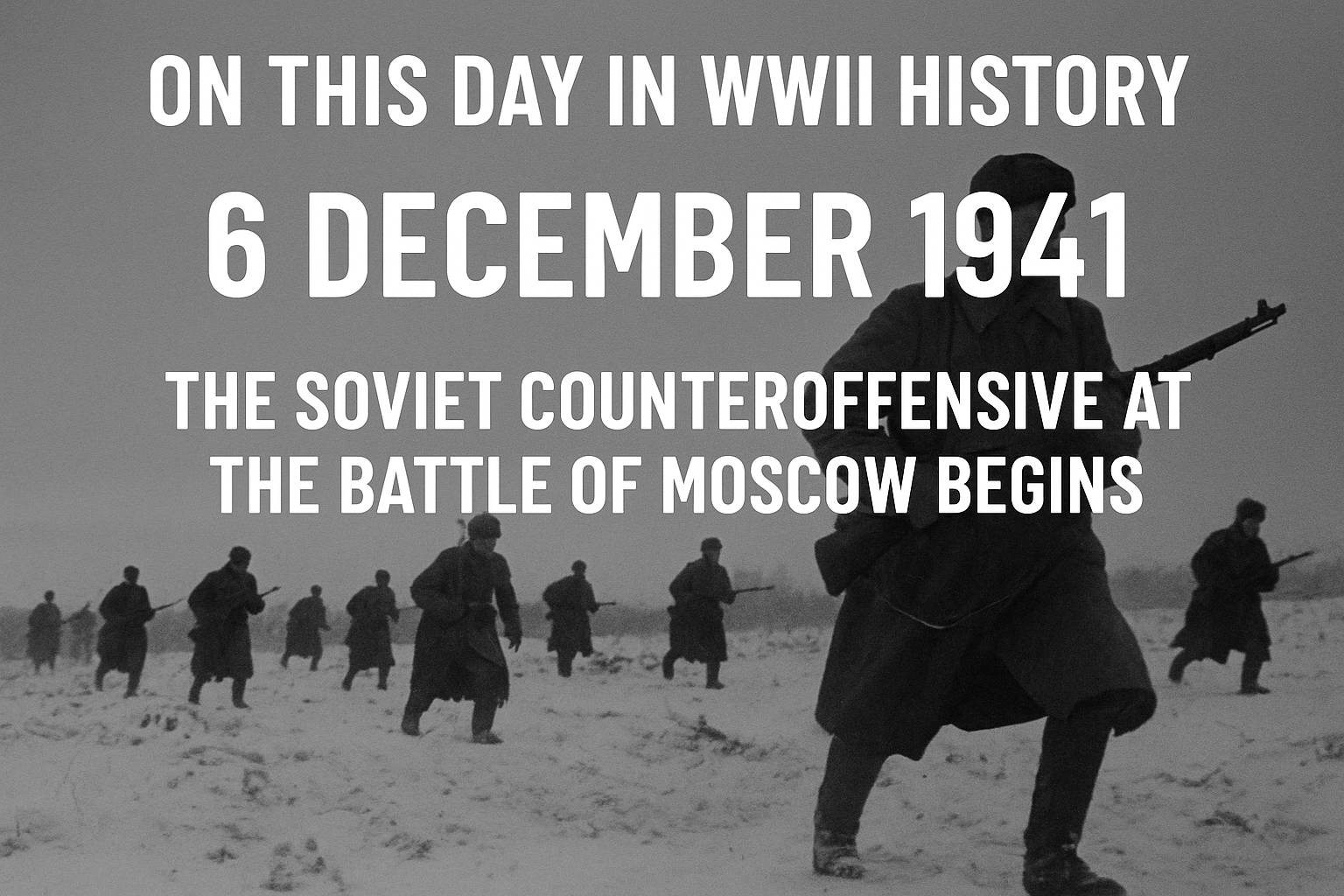
On This Day in WWII History: The Soviet Counteroffensive at Moscow Begins – 6 December 1941
On 6 December 1941, one of the most pivotal turning points of the Second World War unfolded on the frozen outskirts of Moscow. After months of relentless German advances under Operation Barbarossa, the Red Army launched a massive counteroffensive that would not only save the Soviet capital but also deliver Hitler his first major defeat of the war.
The Situation Before the Counterattack
By early December 1941, German forces had pushed dangerously close to Moscow. Exhausted, under-supplied, and suffering in temperatures dropping as low as –30°C, the Wehrmacht expected the Soviet defence to collapse at any moment.
However, Soviet forces had been reinforced by fresh troops from Siberia — soldiers specially trained and equipped for extreme winter conditions.
Intelligence confirmed that Japan would not attack the USSR, allowing Stalin to redeploy these elite units westward. This decision proved decisive.
6 December 1941: The Red Army Strikes Back
On this day, the Red Army launched a coordinated counteroffensive along a 1,000-kilometre front. Soviet infantry, cavalry, ski battalions, and newly arrived tank units surged against the weakened German lines.
Key outcomes of the offensive:
- The German advance on Moscow was halted permanently.
- The Wehrmacht was pushed back between 100–250 kilometres in the following weeks.
- The myth of German invincibility was shattered.
- It marked the first major strategic defeat for Hitler in World War II.
The Battle of Moscow became one of the largest and most brutal campaigns of the war, but the events of 6 December set in motion a shift in momentum that would ultimately shape the rest of the conflict.
Why This Day Matters
The Soviet counteroffensive proved that Germany could be stopped — and that the Eastern Front would become a long, grinding struggle. What happened on 6 December 1941 changed the psychological landscape of the war, lifting Allied morale and showing the world that the Axis advance was not unstoppable.
More than just a military manoeuvre, this moment symbolises resilience, sacrifice, and the critical role of the Eastern Front in determining the outcome of World War II.